Showing posts with label Gallantry Medals. Show all posts

Thursday, 26 December 2024

Frederick Pyne MM, Royal Garrison Artillery.

GV Military Medal. 1914-15 Trio.
35986 Gnr. F. J. Pyne, Royal Garrison Artillery.

Frederick John Pyne was born in Stoke Damerel, an inner suburb of Plymouth, Devon, on 30th September 1892. He was the son of John Pyne, an instructor in the Royal Navy Reserve, and his wife Catherine. The six members of the family, John (39), Catherine (32), Margaret Catherine (10), Frederick John (8), Arthur Patrick (4) and John Daniel (1) are listed on the 1901 Census as living at 2 Fairview, Hamworthy, Dorset.

Although his two younger brothers would eventually follow in their father's footsteps and join the Royal Navy, Frederick Pyne chose the army, attesting for the Royal Artillery at Dorchester on 18th August 1911. He was 18 years 9 months old and had been working as a shop assistant.

Following the outbreak of the First World War, Gunner Frederick Pyne served on the Western Front with the Royal Garrison Artillery from 15th September 1915. His Service Records have not survived so details of the next three years are lacking but he must have been an efficient soldier. He was named in Sir Douglas Haig's Despatch of 9th April 1917 as "deserving of special mention", this appearing in the London Gazette of 18th May 1917. A later Gazette entry on 11th February 1919 recorded his award of the Military Medal for "bravery in the field" while serving with the 35th Siege Battery, Royal Garrison Artillery.

On 20th August 1918, Frederick married Elizabeth Ann Todd and the 1921 Census records him as living with his in-laws' family at 50 Osborne Avenue, South Shields and working as a labourer in the Middle Docks. On the 4th October 1923, the couple's son, Norman Pyne, was born. The 1939 Register lists the Pyne family as living at 18 Pine Avenue, Cleadon, South Shields and notes that Frederick was an electric crane driver in the dry docks and a member of the Auxiliary Fire Service, which suggests that he may also have been awarded the WW2 Defence Medal.

Of Frederick's two brothers who had joined the Royal Navy, Chief Petty Officer Arthur Patrick Pyne was killed in action at the age of 43 when his ship, H.M.S. Foylebank, was attacked and sunk by Junkers JU87 "Stuka" dive bombers on 4th July 1940 while Chief Petty Officer Telegraphist John Daniel Pyne died in 1945.

When Frederick John Pyne eventually retired, an interesting article appeared in a local paper.

After 40 years of "driving" the Middle Dock and Engineering Co's 30-ton travelling crane, Mr. Frederick John Pyne of Pine Avenue, Cleadon, has retired. "It has been an interesting life, being able to see all the river traffic and meeting all the sea-going folk," he told me. He was born in Bournemouth (sic), but after all this time he could certainly qualify to be a South Shields man by adoption.

One of his most vivid memories is a piece of quick thinking during the summer of 1956. His crane was working on the steamer Cochrane with the whaler Southern Harvester alongside. The 30-ton jib began to "run away." After switching off the electricity, Mr. Pyne threw a thick floor mat into the gear wheels. The wheels chewed up 14 inches of it, but eventually the jib stopped falling and the danger of a nasty and costly accident was avoided. Later it was found that the brake band had broken.

Excitement is nothing new to Fred Pyne. He was a regular soldier when the 1914 war broke out. For three and a half years he served as a signaller with the Royal Artillery in France and Belgium. He was commended five times for gallantry, won the Military Medal and was mentioned in despatches.

To mark his retirement and to show their appreciation, his workmates have presented him with a silver watch.

Frederick Pyne died in 1971, his death being registered at South Shields in the third quarter of that year.

Monday, 27 December 2021

Cpl. Vincent Stanton Cassarley MM.

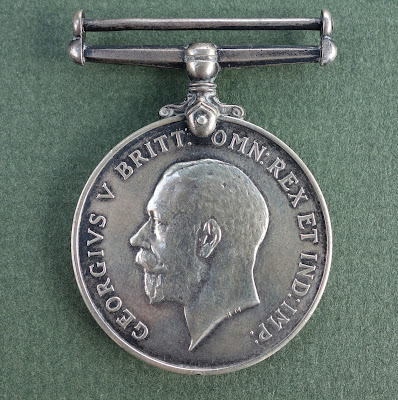
British War Medal 1914 - 1920.
Cpl. V. S. Cassarley, West Yorkshire Regiment.

Vincent Stanton Cassarley was born on 22nd September 1888 and his birth was registered in Halifax in the last quarter of that year. Some sources mention that he was actually born in India and while it is true that Vincent's father, John, had been born in Secunderabad and had enlisted in the 108th Foot as a 12 year old drummer boy in October 1854, eventually being promoted to Sergeant, and finally being discharged in October 1881 at the age of 39, the place of Vincent's own birth remains somewhat in doubt.
By the time of the 1891 Census, the Cassarley family consisting of John Cassarley, a 47 year old life assurance agent who had been born in Ireland, his wife Ann, aged 39 and born in Halifax and their four children, Edward Penno (16 years old), Annie (14 years old), Mary (4 years old) and Vincent (2 years old), were living at 8 East Street, Northowram, Halifax. Some time later, the family moved to Stannary Street in Halifax and John found work as a machine man at the Millerain Mill. On Thursday 9th July 1896, a tragic accident occurred, which was reported in the Yorkshire Evening Post the following day.
 
Yesterday afternoon a shocking fatality occurred at the mill of the British Millrain Company (Limited), Gaol Lane, Halifax. John Cassarley (51), of Stannery Street, who is employed at the mill, ascended a step-ladder in order to knock a strap off a pulley. For this purpose he used a bar of iron, but it was wrenched out of his hand, and after being carried round between the pulley and the strap, struck him on the right side of the head. He was knocked off the ladder, and died an hour or two afterwards. Deceased was an ex-army man and in receipt of a pension.
 
An inquest was held a few days later. The doctor who had carried out the post-mortem stated that death had resulted "from effusion of blood on the brain and shock to the system" and a verdict of accidental death was returned.

One can only speculate about the effect of her husband's death on Ann Cassarley, who now found herself a widow with three children to care for. The 1901 Census records her as a boarding house keeper at 8 Union Street South, Halifax, with her two daughters, Mary (14) and Florence (9). Vincent Cassarley, now aged 12, is recorded as one of the 252 children resident at "The Orphanage", Savile Park, Halifax. The rules of the institution stated that children admitted "must be such as have been deprived by death of both parents, or of their fathers, and whose mothers or other surviving relatives are unable to provide means of subsistence and of education."
 
Interestingly, a "Novel Short Story" by a Vincent Cassarley, entitled "Dr Marient's Strange Experiment", in which a ne'er-do-well spendthrift offers to take part in a scientific experiment with a high risk of death in return for £500, was published in Pearson's Weekly on 4th July 1907. It is impossible to ascertain if the author of this rather odd tale is the same Vincent Cassarley although the name is rather uncommon.
The 1911 Census records the family as living at  11 West Grove Terrace, Halifax. Vincent, now aged 22, is again living with his mother and working as a clerk in a local mill. His sister Mary (24) is working as a restaurant waitress while his younger sister Florence (19) is a confectionery packer.
At around this time, Vincent must have joined the local Territorials, enlisting in the 6th Battalion of the Prince of Wales' Own (West Yorkshire Regiment). He may have been influenced by the example of his elder brother, Edward, who had joined the 3rd West Yorkshire (Militia) in 1897 and having enlisted in the regular army the following year went on to serve for seven years in India.

Following the outbreak of war in August 1914, the 1/6th West Yorks arrived on the Western Front on 16th April 1915. The Battalion was part of the 146th Brigade, which belonged to the 49th (West Riding) Division. This Division saw hard fighting on the Somme in 1916 and in the Third Battle of Ypres in 1917. At some point, Vincent Cassarley was attached to the 146th Trench Mortar Battery. In the latter part of 1917, he was awarded the Military Medal "for bravery in the field", his award being listed in the London Gazette on 28th January 1918. Vincent's Service Record has not survived but it seems likely that he served on the Western Front until the end of the war.
Having been promoted to Corporal and having won the Military Medal, Vincent Cassarley must have been an efficient and capable soldier. Unfortunately, his return to civilian life was not so successful and throughout the 1920s he seems to have been in trouble with the law and to have had a number of spells in prison.
On Tuesday 26th February 1924, under the headline "A Major's Son's Downfall - Drink Spoils Fine Army Record" the Leeds Mercury reported the story of "Vincent Casserley (sic) (38), a Bradford ex-serviceman, son of a retired Army major, who was sent to prison for four months yesterday for theft." He had pleaded guilty to stealing various overcoats, gloves, other articles and a bowler hat. The article also stated that "Casserley served in the army from 1914 to 1921, and was awarded the Military Medal and Long Service Medal. He had worked at several occupations since, and was given a good character by a former employer at Thackley. During the past few months he had been staying at common lodging houses, and seemed to have gone from bad to worse."

In September 1924, Vincent was again remanded in custody for stealing a motor coat. The Yorkshire Evening Post reported him asking, "May I go to Armley, Sir?" and on being asked why he wanted to go there, he replied, "Because there is better accommodation there, Sir." This elicited much laughter from the court.
The death of Vincent's mother was registered in the first quarter of 1927. On 14th March of that year, the Yorkshire Evening Post reported that "Vincent Cassarley, (38), clerk, of no fixed abode was sentenced to three months hard labour for attempting to steal a rug and other articles from (a) car. There were previous convictions against him at Leeds, Bradford and Wakefield."
Little is known of Vincent Cassarley in the next 12 years but his lot is unlikely to have improved. The 1939 Register records him as living in the Church Army Labour and Lodging Homes at 3 Cambridge Terrace, Oxford. His occupation is given as a clerk at an engineers'.

Soon after this, Vincent Cassarley moved to London and found employment as a clerk / labourer at the Royal Hospital, Chelsea, the home of the Chelsea Pensioners. Unfortunately, he still had problems with alcohol and on two occasions in 1941 was arrested for drunkenness. On Sunday 13th April 1941, he was arrested for being drunk and disorderly and trying to hold up the traffic in Beaufort Street, Chelsea. He was fined 7s. 6d. As this was during the Blitz, perhaps his drinking is understandable. Three days later, during one of the heaviest air raids of the war, the Royal Hospital itself was hit by an aerial mine that destroyed the East Wing and damaged other parts of the building, killing four nurses, the wardmaster and eight pensioners. Thirty seven other people were injured in the attack.
In November of the same year, Vincent was again arrested for being drunk on the pavement of Royal Hospital Road at 12.45am. This time he was fined 10s.
Vincent Cassarley died at the age of 58, his death being registered in Hammersmith in the first quarter of 1948. Given the rather troubled and unsettled life that Vincent Cassarley seems to have had, I consider it somewhat remarkable that his British War Medal has survived as a testament to the fact that, whatever his other faults, he volunteered to serve his country in the Great War of 1914 - 1918.

Saturday, 30 December 2017

Cool Courage And Devotion To Duty.

GV Distinguished Conduct Medal. 1914 Trio.
8669 Pte. T. C. Cawthorne, 1st East Yorkshire Regiment.


Thomas Charles Cawthorne was born on 31st May 1889, the son of Thomas Cawthorne, a dealer of cat's meat, and his wife Sarah. The couple already had a son, George, and a daughter, Sarah, and resided at 35 Cranbrook Street, Bethnal Green. The street is pictured below.

On 14th June 1907, Thomas enlisted in the Militia as a volunteer in the 5th Royal Fusiliers. His Attestation Papers describe him as 18 years old, 5' 11" tall, 148lbs, and with a fair complexion, grey eyes and brown hair. His trade is given as carman. It seems that he quickly decided that the military life would suit him as on 9th October 1907, Thomas enlisted as a regular soldier in the East Yorkshire Regiment. Unfortunately, Thomas Cawthorne's Service Papers for his time in the East Yorks have not survived. However, the few details that are known are particularly interesting.
On the outbreak of war, Thomas was serving with the 1st East Yorkshire Regiment and went to France with the Battalion on 8th September 1914. The Battalion fought on the Western Front for the whole war, taking part in the Battles of the Aisne, Armentieres, the Somme, Arras, and Third Ypres. On 21st March 1918, the Battalion was at Saulcourt and came under heavy shelling during the opening phase of the Kaiser's Battle and it was here that Thomas Cawthorne's bravery earned him the Distinguished Conduct Medal. A total of 134 DCMs were won by the East Yorkshire Regiment in the First World War. The citation reads:

"On 21st March, near Saulcourt, for cool courage and devotion to duty. While the camp was being heavily shelled and later on in the day for eleven hours, he assisted, under heavy shell fire, in evacuating the wounded. On 24th March 1918, and again on 28th March, it was largely due to his fine example and energy that many vehicles and horses among the transport were saved under heavy fire."
 
On 14th June 1918, the 1st East Yorks with a strength of 7 officers and 194 other ranks was travelling by train to the Abbeville area. Around 9.30pm, they passed through the station of Coulommiers, which was the first detraining station of the Battalion on its arrival on active service in France. This fact was of great interest to those who had been with the Battalion in September 1914. The Regimental History notes that only one officer and ten men of the original contingent were still with the Battalion, one of whom was Private Thomas Cawthorne.
Little is known of Thomas' life after the war and after his discharge from the army. In 1925, he married Lily Pattison, a local Bethnal Green girl. The death of a Thomas Charles Cawthorne of 10 Maplin Street, Mile End, London is recorded on 4th May 1975. This could possibly be the same man. He would have been 85 years old and Maplin Street is less than one mile from Cranbrook Street, where Thomas grew up. 

Tuesday, 31 May 2011

Gallantry At High Wood, September 1916.

GV Military Medal.
3950 Pte. F. A. G. Stodart, 15th London Regiment (Civil Service Rifles).

Frederick Adolphus Gerald Stodart, the son of James William and Isabel Stodart, was born in 1888. The family are listed on the 1911 Census as living in an 8 room house at 77 Lucien Road, Tooting. By this time, James (62) and Isabel (51) had been married for 28 years and had had nine children, seven of whom were still alive. The oldest was William James Walter, aged 27, a clerk with an engineering firm. He would enlist in the Royal Engineers in 1916 but see only home service during the war. Next was Constance (25), Isabel (24), a basinette saleswoman, Frederick himself (22), a clerk with the railways, Percival Ernest (20), an advertising agent's clerk who would enlist in 1915 and serve with the Middlesex and Essex Regiments and the 2nd Life Guards, Norman (18), a clerk with an engineering firm and Archibald (16), a patent agent's clerk.
Following the outbreak of the Great War, Frederick Stodart, now residing with the family at 2 Charlemont Road, Tooting, enlisted in the 3/15th London Regiment (Civil Service Rifles) at Somerset House on 7th June 1915. His Attestation Papers describe him as just over 5' 5" tall and of good physical development. His religion is noted as Presbyterian. Following a period of basic training, he was sent to the Western Front to join the 1/15th Londons late in January 1916.
The 1/15th Londons, as part of the 47th (London) Division, were involved in the later stages of the Somme campaign and took part in the attack on High Wood on 15th September. A description of the battlefield can be read here. Zero hour for the attack was fixed at 5.50am but "B", "C" and "D" Companies of the Civil Service Rifles had been instructed to crawl out of their trenches and form up in No Man's Land before the actual time in order to be aligned with "A" Company, who were on the extreme right. The former Companies drew a murderous fire from rifles, machine guns and German artillery but "A" Company were able to get across to the German front line with comparatively little loss and were soon engaged in hand-to-hand fighting for the German first and second trenches. Bombing along the trench, trying to establish contact with "B" Company, they soon realised they were alone and, to make matters worse, the tanks that should have led the attack had failed to show up. The attack was in danger of stalling but the situation was saved by the Brigade Stokes mortar battery, which fired nearly 800 rounds in 20 minutes, pounding the German line in front of "C" and "D" Companies and enabling them to get forward and take their objectives. By evening, the whole of High Wood was in British hands and the 15th Londons were digging in in their new trench.

The following day was spent consolidating the new position, all the time under heavy shelling. In the evening, the men moved forward again to a half scraped trench only two feet deep. They set to digging decent cover and no sooner had they finished than they had to stand to in expectation of a German counter attack. And so it went on: a succession of alarms, intense bombardments and standing to. "It was indeed a trying time for all", according to the regimental history. Frederick Stodart had distinguished himself in the fighting and his bravery was recognised by the award of the Military Medal. On the 17th September, he suffered a shrapnel wound to his right hand and thumb. This heralded the end of his active service and on 21st September 1916, Frederick was invalided back to England. He was discharged from the army in March 1917 and awarded a Silver War Badge (no: 152101) and a pension of 20 shillings a week, subject to review after six months. He died in 1955 in Southend on Sea, leaving a wife, Gladys Eva Millicent, whom he had married in 1934 and who lived on until May 1981.

Sunday, 30 May 2010

An Immediate Award Of The MM.


GV Military Medal.

530274 Cpl. - L.Sjt. P. J. Kelly, 15th London Regiment (Civil Service Rifles).


Patrick Joseph Kelly was born in Belfast, the son of Sarah Kelly of 67 Ballygomartin Road, Belfast. By 1914, Patrick was living in London at 28 Elgin Avenue, Maida Hill, and was employed by the Civil Service Commissioners. He joined the 15th (County of London) Battalion, the London Regiment (Prince of Wales' Own Civil Service Rifles) at Somerset House on 8th April 1914. He was 18 years and 2 months old and his Attestation Papers describe him as being 5' 11" tall and of good physical development.

Following the outbreak of the First World War, the 15th Londons prepared for active service. The 1/15th Battalion crossed over to France on 17th March 1915. Patrick Kelly, however, found himself transferred to "C" Company of the 2/15th Battalion, where he served in No: 10 Platoon. On 24th March, he signed Army Form E.624, stating his willingness "to serve in any place outside the United Kingdom in the event of National emergency." Obviously a capable man, he was appointed Lance Corporal (unpaid), then promoted Corporal (paid) by the time the 2/15th arrived in France on 23rd June 1916. He would stay with the Battalion for the next two years, serving on the Western Front (23/06/16 - 21/11/16), Salonica (22/11/16 - 19/06/17), Egypt and Palestine (20/06/17 - 17/06/18) and back to France on 28th June 1918.
In August 1918, the 2/15th Londons were in positions opposite the Dranoutre Ridge. On the night of 21st/22nd August, the 2/14th Londons attacked the ridge and the following night the 2/15th Londons took over the newly-captured line, which was no more than a series of shell holes, and withstood a determined counter-attack. In the words of the Regimental History: "Under continual heavy artillery, trench mortar, and machine-gun fire, we helped to consolidate the new front line. Fighting patrols were pushed forward and great courage was displayed by members of the 2/15th, particularly Sergeant P. J. Kelly's patrol, "C" Company, at Locrehof Farm."
More details of the events are to be found in the account given by Captain Wills, quoted in "The Civil Service Rifles in the Great War" by Jill Knight. A second counter-attack was expected at any moment and Wills hastily organized a wiring party to strengthen their precarious position. "The men worked like Trojans and Kelly worked like three men. We all tore our hands on the wire but nobody minded." Patrick Kelly and his officer then prepared to wire in front of a near-by slag heap. Captain Wills' account continues: "Corporal Kelly and I approached the slag heap from the rear carrying a roll of barbed wire on a stake between us. Both of us had on wiring gloves ... As we approached ... a couple of men came round the left-hand side of the heap. I thought they were part of my wiring party and shouted at them asking what the hell they were doing. A second later a German stick bomb burst some few yards away and I realised that they were Boche. I am afraid I lost my head, tried to tear off my wiring gloves and get to my revolver. Not so Kelly, the Ulsterman, who kept his head and did not try to get off his gloves, but took out a Mills bomb, pulled the pin out with his teeth and threw it. The bomb exploded and got them both."

As Wills afterwards discovered, Patrick Kelly's quick thinking and decisive action had put two German machine-gunners, complete with gun, out of action and saved both their lives. For this Corporal Kelly was awarded an immediate MM. The two Germans had been part of the next counter-attack but, once again, the Civil Service Rifles held their position.
In early September, the Battalion was out of the line, enjoying a period of "rest", supplying working parties for road building and other tasks. On the 12th, a parade was held and Patrick Kelly and others who had been decorated for the Dranoutre operations were presented with ribbons by the Corps Commander.

In the last stages of the war, Patrick suffered a gun shot wound to the wrist, resulting in a degree of disablement of 40%. He was discharged from the army on 11th February 1919 and granted a pension of 12 shillings a week for 26 weeks. Apart from his Military Medal, he would also receive the British War Medal, Victory Medal, Silver War Badge and the King's Certificate for his service with the 15th London Regiment.

Wednesday, 26 May 2010

With Most Magnificent Courage.


GV Distinguished Conduct Medal.

5822 Pte. P. C. Blazeby, 2nd Rifle Brigade.


Percy Charles Blazeby was born in Ilford and his birth registered in the last quarter of 1898, but he does not seem to be recorded on the 1901 Census. His army service number would suggest that he enlisted for the army as a career soldier after the outbreak of the First World War. He certainly didn't go to France before 1916 as he is not entitled to the 1914 or 1914-15 Star; presumably he would have been under age until after his 18th birthday in late 1916.
In 1917, Percy was on the Western Front serving in the 2nd Rifle Brigade, a regular battalion which was part of the 8th Division. On July 31st, the 3rd Battle of Ypres began when nine divisions of the Fifth Army attacked east and north east of Ypres. The 2nd Rifle Brigade took part in the 8th Division's attack on the Westhoek Ridge, advancing soon after 10.00am but being unable to keep up with the artillery barrage and suffering heavy casualties from machine-gun and rifle fire on the forward slopes of the ridge. At 1.00pm, the Battalion were holding a defensive line 700 yards in length and orders were later received to consolidate the position.

From 5.00pm till dark, the enemy made repeated efforts to push forward. According to the account published in The Rifle Brigade Chronicle 1919, "The enemy kept all our posts under very heavy rifle and machine-gun fire, and any movement of runners, etc., was attended by great danger." The Rifle Brigade History states: "From 5.00pm onwards the enemy continually threatened the position of the Battalion on the south of the railway. All available S.A.A. was sent up." It seems most likely that it was here that Percy Blazeby's gallantry was recognized by the award of the DCM. The announcement of the award first appeared in the London Gazette on 22nd October 1917 and the full citation on 26th January 1918.

"For conspicuous gallantry and devotion to duty when acting as Battalion runner. He carried many messages to advanced positions under the most dangerous conditions, continually volunteering for another run when all the other runners were either killed or wounded. When a hostile counter-attack was attempted he went back through heavy machine-gun and sniping fire and succeeded in bringing up ammunition which was urgently required. Throughout the day he behaved with most magnificent courage."

The 2nd Rifle Brigade took part in another attack in the same area on 16th - 17th August, when their task was to mop up after the two attacking battalions. Following this there was a period of training in Kortepyp Camp before a return to brigade support near Ploegsteert Wood on 11th September. On the 19th, the Battalion moved into the line in the St. Yves - Warneton sector and here, on 23rd, the enemy made an unsuccessful attempt to raid the Battalion's position. According to the Regimental History, no Germans managed to enter the British trenches but casualties were inflicted on both sides. Percy Charles Blazeby is recorded as having been killed in action on this day. He is remembered with honour in Prowse Point Military Cemetery.