Wednesday, 29 December 2021

L.Cpl. L.W. Griffiths, 15th London Regiment.

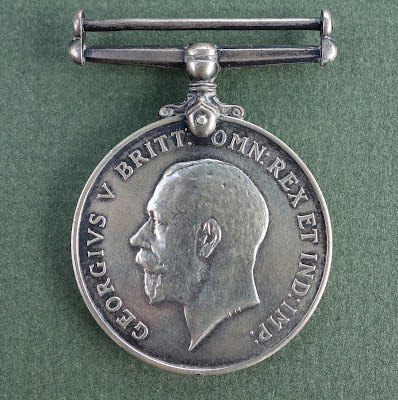
A small Sports Medal for the London Territorial Athletic Sports, inscribed to L.Cpl. L. W. Griffiths, Civil Service Rifles, for the Marathon 1913. (28mm diameter)

L. W. Griffiths enlisted in the 15th London Regiment (Civil Service Rifles) in March 1909, was allotted service number 912 and joined the 6th Company. In June of the same year, the Companies were renamed with letters and the 6th Company became "F" Company. In November 1909, Griffiths was one of a number of recruits who had failed to qualify in Standard Test, Table A, and was required to carry out additional practices in order to reach the required standard. This appears to have been successful as he was appointed Lance Corporal on 15th April 1912 and in Regimental Orders No: 10 (November) 1912, he is listed as one of the men entitled to wear an Efficiency Star.

On 16th February 1913, Griffiths re-engaged for a further year with the Territorial Force and did the same the following year. However, on 4th May 1914, he was discharged at his own request.
Although the identification is by no means certain, L.W. Griffiths could be Lionel Warburton Griffiths, born in 1887, who appears on the 1911 Census as a municipal clerk (Territorial) working for the London County Council. He was commisioned as a Lieutenant in the 1/11th London Regiment (Finsbury Rifles) and saw service in Gallipoli. Promoted to Captain, he later served with the Royal Fusiliers and was Mentioned in Dispatches.

This medal was manufactured by John Pinches, Medallist, of Albert Embankment, London. This company was founded c1841 and was taken over by the Franklin Mint of Philadelphia, USA, in 1969.

John Alexander Binyon, Paget's Horse.

Queen's South Africa Medal with Clasps "Cape Colony", "Orange Free State", "Transvaal", "South Africa 1901" and "South Africa 1902".
31039 Pte. J. A. Binyon, 51st Company, Imperial Yeomanry.
 
Bank clerk William John Binyon married Maria Elizabeth Peacock on 30th August 1879 and their first child, John Alexander Binyon, was born on 24th November 1880. In April 1881, the family were living on Richmond Road, Kingston on Thames. John Alexander was baptised on 18th December 1881 in All Saints Church, Kingston. The family had now moved to nearby Thorpe Road. The 1891 Census records the family, now consisting of William (33), Maria (36) and their four children, John Alexander (10), Evelyn Maria (8), Hilda Margaret (5) and Herbert William (2), together with a 24 year old Welsh servant girl called Mary Isaacs, living at 27 King's Road, Kingston on Thames.
By the time of the 1901 Census, the family had moved to 59 Old Southend Road, Southend, and William, now aged 43, was working as chief cashier at the London & County Bank. John Alexander Binyon does not appear on the 1901 Census as exactly one month before, on 1st March 1901, he had walked into a recruitment office in Carlton Street, St James, London and enlisted in the ranks of Paget's Horse, a privately raised unit of the Imperial Yeomanry, agreeing to serve one year with the Colours. The Medical Officer, Hastings Stewart, had examined him the previous day, found him to be 5' 6" tall, 138lbs in weight, with light brown hair, blue eyes and a fair complexion and pronounced him "fit for the army." His Attestation Papers state his age as 20 years and 3 months, his religion as Church of England, his trade as (architect's) assistant and mention that he had served 2 years with the 1st Essex Volunteer Artillery.


Newly recruited into the 51st Company, 19th Battalion Imperial Yeomanry, John Alexander Binyon was soon on his way to South Africa to play his part in the fight against the Boers. His Papers state that his service there was from 18th March 1901 till 28th April 1902, a total of one year and 42 days, which earned him entitlement to the Queen's South Africa Medal. In January 1902, while serving with Lord Methuen's column, he became ill with a severe case of enteric fever and was admitted to Mafeking Hospital. In March 1902, a medical board at Kimberley examined John's case, decided it was the result of his conditions of service and the climate and recommended his return to England. He was still suffering from debility and had lost a lot of weight.

Soon after his return to England, John was discharged at Shorncliffe Camp on 29th May 1902. He had served a total of one year and 90 days in the Imperial Yeomanry. His intended place of residence was Reading, where his parents, having moved from Southend, were now living. At some point in the next few years, it seems that John moved to Lancashire and met a woman called Emily Harding. Their son, Alexander William Binyon, was born on 7th December 1907. The family appear on the 1911 Census which gives their address as 9 Ellison Street, Green Lane, Stoneycroft and John's occupation as a general labourer working for a sugar refiner. According to the online genealogy sources, the marriage of John and Emily only seems to have been registered in the last quarter of 1914. Were they just living together when they filled in the 1911 Census but not legally married? Did the outbreak of war and John's imminent prospect of going overseas spur them to legalise their relationship? Or are the online sources at fault? It is impossible to say for sure but there certainly seems to be ample scope for speculation here.

When war broke out in August 1914, 951 Bombardier John Alexander Binyon served with the Royal Field Artillery on the Western Front from September 1915. When the Territorial Force was renumbered in 1917, his new number (675181) indicates service with the 285th Brigade (2/1st West Lancashire) RFA, part of the Divisional artillery for 57th (2nd West Lancashire) Division. John later transferred to the Royal Engineers. He survived the war but sadly his younger brother, Herbert William Binyon, was killed with the 102nd Canadian Infantry in the Battle of Vimy Ridge on 12th May 1917. He was 28 years old. Around the beginning of April 1918, John's wife Emily also died although the cause of death is not known. John returned to live with his parents, who were now in Wallingford, for a couple of years, and then seems to have returned to the Liverpool area.

On 22nd February 1922, John Alexander Binyon married Jane Jones, his second wife, at the church of St John the Evangelist in Breck Road, Everton. He was 41 years old and working as a commercial traveller. His new wife was 23. In the early 1930s, John and Jane moved back to London and were living at 68 Weltje Road, Hammersmith. In 1936 the couple were at 8 Bickenhall Mansions W1. The 1939 Register records John, now working as a housekeeper and office caretaker, living with his wife on the Strand in the City of Westminster. In the early 1960s, John, again a widower, lived at 179 Holders Hill Road, NW7. He died on 31st July 1963 at the age of 82.

Tuesday, 28 December 2021

Police Constable Alfred Thomas Rodd.

Jubilee (Police) Medal 1897.
Coronation (Police) Medal 1902.
P.C. A. Rodd, T Division (Hammersmith), Metropolitan Police.

Alfred Thomas Rodd was born in Fremington, near Barnstaple in Devon, on 7th January 1871 but three months later when the 1871 Census was taken, the Rodd family consisting of Thomas (43), his wife Mary Jane (44), three daughters Bessie (8), Elizabeth (5) and Selina Grace (3) together with the three month old Alfred were living at Kingsheanton near Marwood. On 16th October 1876, Alfred and his sister Selina Grace started school at the recently opened Marwood Board School run by Mr Frank Palmer. The 1881 Census lists the family as resident in the nearby village of Prixford. Alfred's father worked as a thatcher and, judging from the old photo of some Prixford cottages below, he would not have been short of work in the village and surrounding area. Ten years later, the 20 year old Alfred was still living with his parents in Prixford and working as a tailor.
 
It seems that Alfred was not satisfied with life as a tailor and some time later he moved to London, where, on 19th June 1893, he applied to join the Metropolitan Police at New Scotland Yard. At the time of his physical examination, he was 22 years of age, 5' 9" tall, weighed 12 stone 8lbs, and had black hair, dark eyes and a dark complexion. His address was given as 81 Miles Buildings, Edgware Road, and his last employer named as Mr Skinner of Marwood. Alfred was given Warrant Number 78782 and attached to T Division (Hammersmith) of the Metropolitan Police. The Hammersmith police station at this time (1870 - 1939) is pictured below.
 
On 17th August 1897, Alfred Rodd married Hester Jane Fry at Christ Church in Marylebone. Alfred would remain with T Division for the whole of his service with the Metropolitan Police. Little is known of his day-to-day work except for one incident reported in The West London Observer on Friday 6th April 1900. At 7.30am on the morning of Sunday 1st April 1900, P.C. Rodd was on duty on the Middlesex side of Hammersmith Bridge when he was informed that there was a man lying on the foreshore on the Surrey side of the river. This was found to be the body of P.C. William Goulder, who appeared to have drowned. With some assistance, P.C. Rodd brought the body to the steps and it was taken to the police station in an ambulance. The body had been fully dressed with a lantern still attached in front of the belt but the constable's helmet was missing and his watch had stopped at 2.18am, suggesting that this was the time he had fallen into the water. Alfred Rodd gave evidence at an inquest the following Wednesday, as did a number of other witnesses who had seen and spoken to P.C. Goulder as he walked his beat that Saturday evening and Sunday morning. A verdict of accidental death was reached and notice taken of the dangerous condition of the towpath on the Surrey side of the river at high tide.
 
Alfred and Hester Rodd are recorded on the 1901 Census as living in Fulham with their two children, three year old Alfred Edwin and one year old Bessie. By the time of the 1911 Census, the family, now comprising Alfred (40), Hester (38), Alfred Edwin (13), Bessie (11) and Doris (6), had moved to 16 Beryl Road in Hammersmith. Alfred Edwin would later join the Royal Engineers and serve on the Western Front as a qualified telegraph operator from January 1917, thus earning entitlement to the British War Medal and Victory medal for his service in the Great War.
 
Alfred Rodd resigned from the Metropolitan Police on 29th December 1919. He was 48 years old and had served for a total of 26 years and 193 days. His intended place of residence was given as 33 Marlborough Road, Ilfracombe. Later Alfred and Hester moved to Station Road, Ilfracombe, where they lived for a number of years.
In early 1938, the Rodds moved to 37 North Street, South Molton, Devonshire, and after only six weeks in their new home, Alfred fell ill and died a few days later on 8th March. He was 67 years old and left effects valued at £92. Hester, his widow, died in 1961.

Monday, 27 December 2021

Cpl. Vincent Stanton Cassarley MM.

British War Medal 1914 - 1920.
Cpl. V. S. Cassarley, West Yorkshire Regiment.

Vincent Stanton Cassarley was born on 22nd September 1888 and his birth was registered in Halifax in the last quarter of that year. Some sources mention that he was actually born in India and while it is true that Vincent's father, John, had been born in Secunderabad and had enlisted in the 108th Foot as a 12 year old drummer boy in October 1854, eventually being promoted to Sergeant, and finally being discharged in October 1881 at the age of 39, the place of Vincent's own birth remains somewhat in doubt.
By the time of the 1891 Census, the Cassarley family consisting of John Cassarley, a 47 year old life assurance agent who had been born in Ireland, his wife Ann, aged 39 and born in Halifax and their four children, Edward Penno (16 years old), Annie (14 years old), Mary (4 years old) and Vincent (2 years old), were living at 8 East Street, Northowram, Halifax. Some time later, the family moved to Stannary Street in Halifax and John found work as a machine man at the Millerain Mill. On Thursday 9th July 1896, a tragic accident occurred, which was reported in the Yorkshire Evening Post the following day.
 
Yesterday afternoon a shocking fatality occurred at the mill of the British Millrain Company (Limited), Gaol Lane, Halifax. John Cassarley (51), of Stannery Street, who is employed at the mill, ascended a step-ladder in order to knock a strap off a pulley. For this purpose he used a bar of iron, but it was wrenched out of his hand, and after being carried round between the pulley and the strap, struck him on the right side of the head. He was knocked off the ladder, and died an hour or two afterwards. Deceased was an ex-army man and in receipt of a pension.
 
An inquest was held a few days later. The doctor who had carried out the post-mortem stated that death had resulted "from effusion of blood on the brain and shock to the system" and a verdict of accidental death was returned.

One can only speculate about the effect of her husband's death on Ann Cassarley, who now found herself a widow with three children to care for. The 1901 Census records her as a boarding house keeper at 8 Union Street South, Halifax, with her two daughters, Mary (14) and Florence (9). Vincent Cassarley, now aged 12, is recorded as one of the 252 children resident at "The Orphanage", Savile Park, Halifax. The rules of the institution stated that children admitted "must be such as have been deprived by death of both parents, or of their fathers, and whose mothers or other surviving relatives are unable to provide means of subsistence and of education."
 
Interestingly, a "Novel Short Story" by a Vincent Cassarley, entitled "Dr Marient's Strange Experiment", in which a ne'er-do-well spendthrift offers to take part in a scientific experiment with a high risk of death in return for £500, was published in Pearson's Weekly on 4th July 1907. It is impossible to ascertain if the author of this rather odd tale is the same Vincent Cassarley although the name is rather uncommon.
The 1911 Census records the family as living at  11 West Grove Terrace, Halifax. Vincent, now aged 22, is again living with his mother and working as a clerk in a local mill. His sister Mary (24) is working as a restaurant waitress while his younger sister Florence (19) is a confectionery packer.
At around this time, Vincent must have joined the local Territorials, enlisting in the 6th Battalion of the Prince of Wales' Own (West Yorkshire Regiment). He may have been influenced by the example of his elder brother, Edward, who had joined the 3rd West Yorkshire (Militia) in 1897 and having enlisted in the regular army the following year went on to serve for seven years in India.

Following the outbreak of war in August 1914, the 1/6th West Yorks arrived on the Western Front on 16th April 1915. The Battalion was part of the 146th Brigade, which belonged to the 49th (West Riding) Division. This Division saw hard fighting on the Somme in 1916 and in the Third Battle of Ypres in 1917. At some point, Vincent Cassarley was attached to the 146th Trench Mortar Battery. In the latter part of 1917, he was awarded the Military Medal "for bravery in the field", his award being listed in the London Gazette on 28th January 1918. Vincent's Service Record has not survived but it seems likely that he served on the Western Front until the end of the war.
Having been promoted to Corporal and having won the Military Medal, Vincent Cassarley must have been an efficient and capable soldier. Unfortunately, his return to civilian life was not so successful and throughout the 1920s he seems to have been in trouble with the law and to have had a number of spells in prison.
On Tuesday 26th February 1924, under the headline "A Major's Son's Downfall - Drink Spoils Fine Army Record" the Leeds Mercury reported the story of "Vincent Casserley (sic) (38), a Bradford ex-serviceman, son of a retired Army major, who was sent to prison for four months yesterday for theft." He had pleaded guilty to stealing various overcoats, gloves, other articles and a bowler hat. The article also stated that "Casserley served in the army from 1914 to 1921, and was awarded the Military Medal and Long Service Medal. He had worked at several occupations since, and was given a good character by a former employer at Thackley. During the past few months he had been staying at common lodging houses, and seemed to have gone from bad to worse."

In September 1924, Vincent was again remanded in custody for stealing a motor coat. The Yorkshire Evening Post reported him asking, "May I go to Armley, Sir?" and on being asked why he wanted to go there, he replied, "Because there is better accommodation there, Sir." This elicited much laughter from the court.
The death of Vincent's mother was registered in the first quarter of 1927. On 14th March of that year, the Yorkshire Evening Post reported that "Vincent Cassarley, (38), clerk, of no fixed abode was sentenced to three months hard labour for attempting to steal a rug and other articles from (a) car. There were previous convictions against him at Leeds, Bradford and Wakefield."
Little is known of Vincent Cassarley in the next 12 years but his lot is unlikely to have improved. The 1939 Register records him as living in the Church Army Labour and Lodging Homes at 3 Cambridge Terrace, Oxford. His occupation is given as a clerk at an engineers'.

Soon after this, Vincent Cassarley moved to London and found employment as a clerk / labourer at the Royal Hospital, Chelsea, the home of the Chelsea Pensioners. Unfortunately, he still had problems with alcohol and on two occasions in 1941 was arrested for drunkenness. On Sunday 13th April 1941, he was arrested for being drunk and disorderly and trying to hold up the traffic in Beaufort Street, Chelsea. He was fined 7s. 6d. As this was during the Blitz, perhaps his drinking is understandable. Three days later, during one of the heaviest air raids of the war, the Royal Hospital itself was hit by an aerial mine that destroyed the East Wing and damaged other parts of the building, killing four nurses, the wardmaster and eight pensioners. Thirty seven other people were injured in the attack.
In November of the same year, Vincent was again arrested for being drunk on the pavement of Royal Hospital Road at 12.45am. This time he was fined 10s.
Vincent Cassarley died at the age of 58, his death being registered in Hammersmith in the first quarter of 1948. Given the rather troubled and unsettled life that Vincent Cassarley seems to have had, I consider it somewhat remarkable that his British War Medal has survived as a testament to the fact that, whatever his other faults, he volunteered to serve his country in the Great War of 1914 - 1918.

Wednesday, 30 December 2020

Service in Egypt, Sudan and South Africa.


Queen's South Africa Medal with Clasps "Transvaal" and "South Africa 1902".
3631 Pte. R. Frost, Lincolnshire Regiment.
 
Thomas Edward Frost, a shipwright, and Betsy Crisp were married in Grimsby in 1873. Two years later, on 21st April 1875, they baptised their son, Robert Christopher Frost, in the parish church of St Andrew, Great Grimsby. By the time of the 1891 Census, the family were living at 1 Back Foundry Lane, Grimsby, and Robert is recorded as a 15 year old labourer.
On 17th July 1893, Robert enlisted in the Lincolnshire Regiment, agreeing to serve 7 years with the Colours and 5 years in the Reserve. He had already served some time in the 3rd Lincolnshire Militia and must have decided that life in the army would be better than working as a general labourer. His Attestation Papers describe him as 18 years and 4 months old, with a fair fresh complexion, brown hair and blue hazel eyes. His religion was Church of England. His father, Thomas, is noted as his next of kin although by 1901 he would be an inmate of the county asylum at Bracebridge, near Lincoln.
 

On 21st August 1893, Robert transferred from the Depot to the 1st Battalion. His first spell of foreign service came in 1895 when the 1st Battalion was sent to Malta for two years. It was here, in July 1895, that Robert was awarded his 1st Good Conduct Pay. On 3rd February 1897, the Lincolns left Malta for Egypt, where they would take part in the reconquest of the Sudan. Robert Frost took part in the Atbara Campaign and the Expedition to Khartoum in 1898. He would have been present at the Battle of Omdurman on 2nd September 1898. For his service in Egypt and the Sudan, he was awarded the Queen's Sudan Medal and the Khedive's Sudan Medal with clasps "The Atbara" and "Khartoum".
 

The 1st Battalion of the Lincolnshire Regiment left Egypt in October 1898 and sailed for India, where they were stationed in Bangalore. Robert Frost was awarded his 2nd Good Conduct Pay here and in February 1902 was transferred to the 2nd Battalion and sent to join them in South Africa. He would serve 202 days in South Africa during the final stages of the Boer War, thus earning entitlement to the Queen's South Africa Medal featured here.
 
Robert Frost returned to England in September 1902 and transferred to the Army Reserve in December. He was finally discharged from the Reserve on 16th July 1905, having served a total of 12 years. He married soon after this and the 1911 Census records him as working as a bricklayer and living at 26 Guildford Street, Grimsby, with his wife Mary Jane and 4 year old daughter Florence Jennie. In 1913, the couple had a son, Thomas Edward - named after his grandfather. Sadly, this boy came to a tragic end at the age of 13, when, on 29th August 1926, he accidentally hanged himself in his bedroom.  Newspaper reports at the time reported the inquest's verdict of death from misadventure, concluding that the boy had been imitating a scene he had seen at the pictures. It is not known whether Robert Frost served again in the First World War. There was a Robert C. Frost who was awarded a British War Medal and Victory Medal for service in the Army Service Corps but it is uncertain whether this was the same man.
 
Robert Frost later worked as a boiler fitter and died at the age of 61 on 6th February 1937. Like his young son, he is buried in Scartho Road Cemetery, Grimsby. According to the 1939 Register, Mary Jane Frost and her daughter Florence were still living in 26 Guildford Street just before the Second World War.

Tuesday, 29 December 2020

Wilfred Samuel, an Actor in Paget's Horse.

Queen's South Africa Medal with Clasps "Cape Colony", "Orange Free State", "Transvaal" and "South Africa 1901".
13623 Pte. W. Samuel, 51st Company, Imperial Yeomanry.
 
Wilfred Samuel, the second child of Louis Samuel, a furniture manufacturer, was born in Cardiff on 17th October 1878. Wilfred is recorded on the 1891 Census as a 13 year old schoolboy at the boys boarding school run by Jacob Herman Cohen at 47 Buckingham Place, Brighton. His father had been born in Biala, Poland, and was originally a Russian subject but in June 1894, Louis took the oath of allegiance and obtained his Certificate of Naturalization from Herbert Henry Asquith, the future Prime Minister. At the time, the Samuel family was living at Pembroke Terrace, Cardiff.
Following the outbreak of war with the Boers, on 31st January 1900, Wilfred presented himself at 12 Suffolk Street, London, the office of the Imperial Yeomanry Committee, and enlisted in the 51st Company. The 51st was one of the four Companies, subsequently known as "Paget's Horse", raised by George Paget, an amateur soldier and Victorian adventurer. This was an exclusive unit made up of public school gentlemen, who were recruited through advertisements in fashionable London clubs. Paget's Horse wore insignia made up of the letters "PH" and this led to much speculation about its meaning, some wags claiming it stood for "Piccadilly Heroes", "Public House" or "Perfectly Harmless." Wilfred's Attestation Papers describe him as a 22 year old accountant, 5' 4" tall, weighing 121lbs and with dark eyes and hair and a fair complexion. His religion was stated as Jewish. He served in South Africa from March 1900 till November 1900, his Papers mentioning service at Elands River, Ottoshoop, Zeerust and Lindley. Wilfred Samuel's Queen's South Africa Medal is fitted with the clasp "South Africa 1901" and although this is noted in his Service Papers, it is crossed out on the Medal Roll with the annotation "not entitled." The clasp is attached with what look like official rivets so perhaps it was issued to him in error and, as he was not discharged from the Yeomanry until 20th January 1901, he may have felt entitled to it.

Interestingly, when Wilfred returned from South Africa, he was interviewed by a reporter from the South Wales Daily News and an article about his South African war service appeared in the paper on 24th November 1900.

With Paget’s Horse. Cardiffian’s Experience.

Return of Mr Wilfred Samuel.

Mr Wilfred Samuel, son of Mr Louis Samuel, J.P., of Cardiff, arrived home yesterday afternoon, and shortly before 5 0’clock was seen by our reporter. Mr Samuel appeared in excellent health except for an injured arm - wounded however not by a Boer bullet but by blood poisoning. He has seen plenty of exciting adventures. “These began,” he said in reply to questions, “on the voyage out when on board the Winkfield. We collided with the Mexican. It was pitch dark, and we all thought we were going to sink, but the captain’s words reassured us and he asked for volunteers to man the boats to go and try to save the Mexican’s passengers. I volunteered among the rest, and we were pulling about for five hours. At length, when day dawned, we found the Mexican, and brought off the women and children.” 

“When did you land?”

“It was right at the end of March. One of the first people I met in Cape Town was Councillor Ward of Cardiff. He was then waiting for a commission in Robert’s Horse. We went first of all for a month’s training at Maitland Camp, and after that we were engaged in putting down the rebellion in Griqualand West. We had some rough experiences here, and on one occasion 11 of our men were killed at night in their blankets.

“Subsequently,” added Trooper Samuel, “we served under General Carrington at Mafeking, and on the north western side of the Transvaal at Elands River, Zeerust, Ottoshoop, Lichtenburg and Rustenburg. We took part in several engagements and had some narrow escapes. On one occasion, at Elands River, 40 of us were lying on our stomachs for two hours, only being able to crawl, for fear of being shot by the Boer snipers. One of our fellows stood up, and instantly he fell mortally wounded. General Carrington is a fine officer, and much liked by us all, his command including a number of the colonials, who were all found splendid comrades. Here (Zeerust) we witnessed the burning of £500,000 worth of stores to prevent them falling into the hands of the enemy.”

“Any other Welshmen in your battalion?”

“Yes, two. One was Trooper Woolley, of the Gaer, Newport and the other Trooper Lawrence of Ferryside, or somewhere near. He is a brother of Mr Lawrence, the Cardiff civil engineer.

“Meet with any others?”

“Oh yes. Several of the Glamorgan Yeomanry. Norman Biggs I saw at Belmont, and he said he would rather be playing football than fighting. I also saw young Austin and the two Nells. All of them looked very rough and ready for anything.

“I left our battalion, which was known humorously, because of the initials, as “Perfectly Harmless”, at Rustenburg, where I got fever and was sent to Deelfontein, where at the Yeomanry hospital, under the personal superintendence of Lady Chesham, we were splendidly treated. Subsequently I was sent down to Maitland and invalided home. I arrived at Southampton on Tuesday of the present week, and am on two months’ sick furlough, at the end of which time I shall have to report myself at Shorncliffe. On the voyage home I met with a young Welshman named Perry, who is in the Pembrokeshire Yeomanry.”

Trooper Samuel is a modest young fellow, but I managed also to extract from him the fact that he had twice had his horse shot under him. He furthermore declared - and I have no reason to doubt the fact – that Paget’s Horse have been during the campaign very far from “Perfectly Harmless.”


The 1901 Census records Wilfred as living with his father and brother Alfred at 1 Fitzalan Place, Cardiff and gives his occupation as actor. At around this time, he also seems to have begun calling himself Wilfred Stanford Samuel or just Wilfred Stanford, perhaps thinking this sounded more appropriate as a stage name. By 1906, he was the acting manager of the Camden Theatre in London and also a lieutenant in the 17th Middlesex Rifle Volunteers. In 1909, he appears as a sub-lieutenant  in the Royal Naval Volunteer Reserve. The 1911 Census lists him as a theatre manager living in Maida Vale. In November 1913, Wilfred married Grace Clayton Dukeman, the daughter of a Los Angeles Jeweller, but the marriage only lasted six weeks before she left to return to the USA. Finally, in 1922, a court granted Wilfred Stanford Samuel a decree nisi after hearing details of a mocking letter she had written to him from on board the ship taking her back to America. The case was widely reported in the newspapers at the time.

In 1914, Wilfred Stanford Samuel was a lieutenant in the 4th Kings (Liverpool Regiment) attached to the 1st Battalion and went to France on 12th August, thus earning entitlement to the 1914 Star Medal. On 17th April 1915, he left Liverpool on the SS Abinsi (pictured below) bound for West Africa, where he would serve with the Nigeria Regiment in the West African Frontier Force and the Cameroons Expeditionary Force.

After the war, Captain Stanford Samuel returned to England and again took up the profession of acting. He may have found it hard to obtain work as he placed numerous advertisements in the papers at the time asking for employment. "Continuous Active Service Overseas. Aug 4 1914 - Dec 1919. Capt. Wilfred S. Stanford, Character Actor and Management. 20 years' Experience. At Liberty. Will any patriotic management offer engagement?" In the early 1920s, Wilfred's health seems to have worsened and in both April and August 1923, he had spells in hospital caused by "war disability." Sadly, on 1st March 1924, Wilfred  Stanford Samuel died, his recent bouts of ill health most probably a result of his years of service spent in the unhealthy climate of West Africa.
A short obituary appeared in the Western Mail on 7th March 1924.
The death occurred in London of Capt. Wilfred Stanford Samuel, eldest son of the late Mr. Louis Samuel, J.P., of Cardiff, and nephew of Mr. Isaac Samuel, J.P., of Cathedral Road. Capt. Samuel, who was about 45 years old, was born in Cardiff but in early life spent some time in South Africa and Australia. At the time of the Boer War he came home and joined up, and when the Great War came in 1914 he again volunteered and served right through the campaign. He was wounded twice. On one occasion he and a small number of men in France were blown up and he was the only survivor. He was removed unconscious to the base hospital six miles away, and remained in that condition for nearly a week. He saw service in France, Italy and East (sic) Africa. Capt. Samuel was married. The funeral took place on Wednesday at the Jewish Cemetery, Willesden.