Friday, 30 December 2016

Pte. John Dormann, 15th London Regiment.

British War Medal 1914 - 20.
Victory Medal. 
5059 Pte. J. A. Dormann, 15th London Regiment (Civil Service Rifles).

The birth of John Alexander Dormann was registered in 1887 and his baptism took place at St Peter’s church, Fulham, on 23rd August 1893. He was the last of four sons born to Julius Joseph and Emma Dormann. Their four children were Julius (born December 1879), Albert Louis (born 1881), Edward (born July 1883) and John Alexander. The family lived in Rosaville Road, Fulham at least until 1888 but at some point after moved a few streets away to a four room dwelling at 84 Sherbrooke Road. The 1891 Census notes that Julius had been born in Switzerland and was working as a waiter.
By the time of the 1901 Census the three older boys were all employed but still living at home; Julius was a solicitor’s clerk, Albert worked as a grocer’s assistant and Edward was employed as a barber’s assistant. John, now aged 14, was presumably still at school.
After leaving school, John Dormann embarked on a career in the Civil Service and various mentions in the London Gazette chart his progress. In May 1906 he was appointed as a second division clerk and the following August he was assigned to the Post Office. In early 1910 he transferred to the Board of Trade.
The 1911 Census records the Dormann family as still living at 84 Sherbrooke Road, Fulham.  Julius, the father, now aged 57 was still working as a waiter. He and Emma had been married for 32 years. All four sons were single, still living at home, and doing the same jobs. At some point after this, the family moved a few doors down the street to 60 Sherbrooke Road.

On 25th November 1915, John Alexander Dormann enlisted in the 15th London Regiment for the duration of the war. His surviving Attestation Papers state that he was 28 years 9 months old, 5’ 7” tall, and of fair physical development. His occupation is given as a clerk with the Commercial Intelligence Branch of the Board of Trade. In addition, he signed army form E.624 affirming his willingness to serve outside the United Kingdom. John had had to apply to his employer for official permission to enlist and this was granted on 1st December, following which he was embodied in the 3/15th Londons and began his basic training. 
On 13th May 1916, John sailed from Southampton, arriving at the Base Depot at Le Havre the following day. On 15th June, he joined the 1/15th Battalion at Angres, north of Arras. Here, a number of selected men were busy rehearsing for a forthcoming trench raid.
On the night of 3rd July, the raiding party, their faces blackened with charcoal and equipped with the usual trench fighting weapons, including Mills bombs, coshes and bayonets, attempted to get into the German trenches. It seems the Germans suspected what was afoot and were able to bring down an artillery barrage, pinning most of the raiders down in their own front line trench. A few of the men managed to get across No Man’s Land but the raid was not a success; one officer was killed and numerous men wounded, including John Alexander Dormann, who suffered shrapnel wounds to his leg.
The Regimental History did not dwell on this incident, simply stating “Early in July the Battalion was ordered to raid the enemy trenches in the Bois en Hache, just north of Souchez, but although 5 officers and 100 other ranks were specially trained for the event, it was a dismal failure, and it has long been a forbidden topic of conversation in Civil Service Rifles circles.”
John was evacuated away from the front line to a Casualty Clearing Station and then on 5th July 1916 to the 3rd Canadian General Hospital at Boulogne. The next day, he was on his way to England, where he would spend 300 days (8th July 1916 to 3rd May 1917) at the Welsh Metropolitan War Hospital at Whitchurch near Cardiff. In a way, his “Blighty” wound could be seen as an incredible stroke of luck since he missed the later stages of the Somme Battles, in which the 1/15th Battalion suffered terrible casualties in two costly attacks, first on 15th September at High Wood and then on 7th October at the Butte de Warlencourt.
Early in May 1917, John Dormann was granted 10 days’ leave to visit his family in Fulham and then, on 15th June, he was again sailing from Southampton and heading back to the Western Front. He again passed through the Base Depot at Le Havre and on 12th July was back with the 1/15th Battalion. He had just missed another costly attack as the Battalion had had just over 200 casualties, including 56 killed, in the Battle of Messines Ridge in early June.

 
On 28th November 1917, the Battalion took over part of the Hindenburg Line near Graincourt, and the following day John Dormann suffered a shrapnel wound to the left knee. This wound was not so serious as he rejoined the Battalion in early December only to suffer shrapnel wounds to his arm and back on 22nd January 1918 while the 1/15th was engaged in routine trench holding.
John was back with the Battalion when the Kaiser’s Battle opened on 21st March 1918. The 1/15th Londons were in support trenches in Lincoln Reserve on Beauchamp Ridge and under shell fire throughout the morning. By night, the forward battalions were ordered to withdraw and the Londons’ support trenches became the new front line. The situation became increasingly confused and the Battalion was ordered to fall back. At some time on 22nd March 1918, John Dormann was reported as missing. Six months later, he was officially accepted as a POW in Germany.
Once the war was over, John Dormann was quickly repatriated back to the UK, arriving there on 27th November 1918. He was discharged from the army on 19th February 1919 and resumed his duties in the Civil Service. The London Gazette of 7th November 1919 mentions his promotion to Market Officer in the Department of Overseas Trade. In 1922 he married Winifred Rose Cashin. His progress up the Civil Service ladder continued with promotion to Intelligence Officer, Senior Officer and Senior Staff Officer. In the New Year’s Honours List of 1947 he was awarded the MBE.
John Alexander Dormann appears to have retired to Southend, where his death was registered in the first quarter of 1968. He was 80 years old.

Sjt. Rawlins, Scots Greys: A Conman's Victim.

Queen's South Africa Medal with clasps "Relief of Kimberley", "Orange Free State", "Johannesburg" & "Belfast".
4105 Sjt. E. Rawlins, 2nd Dragoons.


Edward Percy Rawlins, the fifth child of Walter and Fanny Rawlins, was born in Pewsey, near Marlborough in Wiltshire, on 21st February 1876. Walter Rawlins was a farmer and cattle dealer and was prosperous enough to be able to send Edward to Newbury Grammar School, where he is listed among the scholars on the 1891 Census. Edward served an apprenticeship with a Mr Biggs of Tunbridge Wells for two years and then on 9th May 1895, at the age of 19 years and 3 months, enlisted in the Royal Scots Greys, agreeing to serve 7 years with the Colours and 5 years in the Reserve. His Attestation Papers describe him as just over 5' 11" tall, and weighing 160lbs with a fair complexion, blue eyes and brown hair. He had scars on his left elbow and the palm of his left hand. His religion was given as Church of England and his profession as shopman.
Edward seems to have made slow but steady progress with his army career, being appointed Lance Corporal on 9th March 1897, granted his first Good Conduct Pay on 9th May the same year and being promoted to Corporal on 19th October 1898. In November 1899, he went with the Regiment to South Africa where he would serve for one and a half years, earning entitlement to the Queen's South Africa Medal with five clasps. He was appointed Lance Sergeant on 17th December 1900 and promoted to Sergeant on 3rd April 1901.

Edward returned to England on 25th April 1901. A further period of home service ensued during which he married Lilly Rose Wasley at St Stephen's Church, Wandsworth, on 14th September 1903. Finally, on 7th August 1905, Edward was transferred to the Army Reserve.
Following his discharge from the army, Edward and his wife moved to Hawthorn Farm, Blythburgh, near Southwold in Suffolk, where he worked as a farmer. On 9th November 1918, Edward, now aged 42, joined the Royal Air Force as a Private, Second Class, but would only serve for six days as the Great War finally came to an end and his services were no longer required. In the 1920s, trading on his experience in the Scots Greys, he successfully ran the Southwold Riding Academy and soon became a well known member of Southwold society.

The story now jumps to the summer of 1933, when a certain Major Leonard T. Crane arrived in Southwold and checked in to the fashionable Marlborough Hotel. Good looking, urbane and with a winning smile and a military bearing, Major Crane soon made a favourable impression on the local gentry with whom he cultivated connections. The Major had an interesting story to tell. He claimed that he had been the co-litigant, together with George V, in a legal action against the National Provincial Bank for the sum of £850 million. The involvement of the monarchy had made the case politically sensitive and, as a result, it was held in camera before Lord Sankey, the Lord High Chancellor of England. Crane's successful pleading of his own case had resulted in the case being won but due to a bureaucratic mistake the £10 million coming to him had been paid into the Chancery Court. Now, Crane went on to explain, releasing his funds from Chancery would require a costly legal process, which he could not at present afford. However, anyone who wished to contribute to the legal costs would be recompensed many times over once the money was released.
Not only was Crane a most persuasive speaker but he had a wealth of official looking documents to back up his story and, at a time of serious economic depression, his story was readily accepted by people who perhaps should have known better. Around 30 of Southwold's residents, including Edward Rawlins, who invested £650 in the enterprise, were taken in by this incredible tale. It was only when Crane came into contact with the Rev. R. N. Pike, Southwold's vicar and a man with some knowledge of the law, that suspicions were aroused. Realising the game was up, Crane fled to London and disappeared. He was eventually tracked down by the "Sunday Graphic" newspaper and the truth finally emerged. Major Leonard T. Crane was a complete fiction. His real name was David Percy Caplice, a timber salesman and bricklayer. The whole sorry saga reached its conclusion in October 1934 when Caplice was found guilty of obtaining money by forgery and false pretences at Suffolk Assizes in Ipswich and sentenced to four years hard labour. His victims were left to bear their losses as stoically as possible. A detailed account of this elaborate hoax can be read here: The Wenhaston Millions.
The whole affair seems to have hit Edward Rawlins hard. He went into a slow decline and died two years later on 14th June 1936, at the age of 60. His estate was valued at £14080 5s 6d, a not inconsiderable sum in those days, and proof perhaps that he wasn't completely financially ruined by the lure of the "Wenhaston Millions."

Thursday, 31 December 2015

With HMS Thunderer At Jutland.


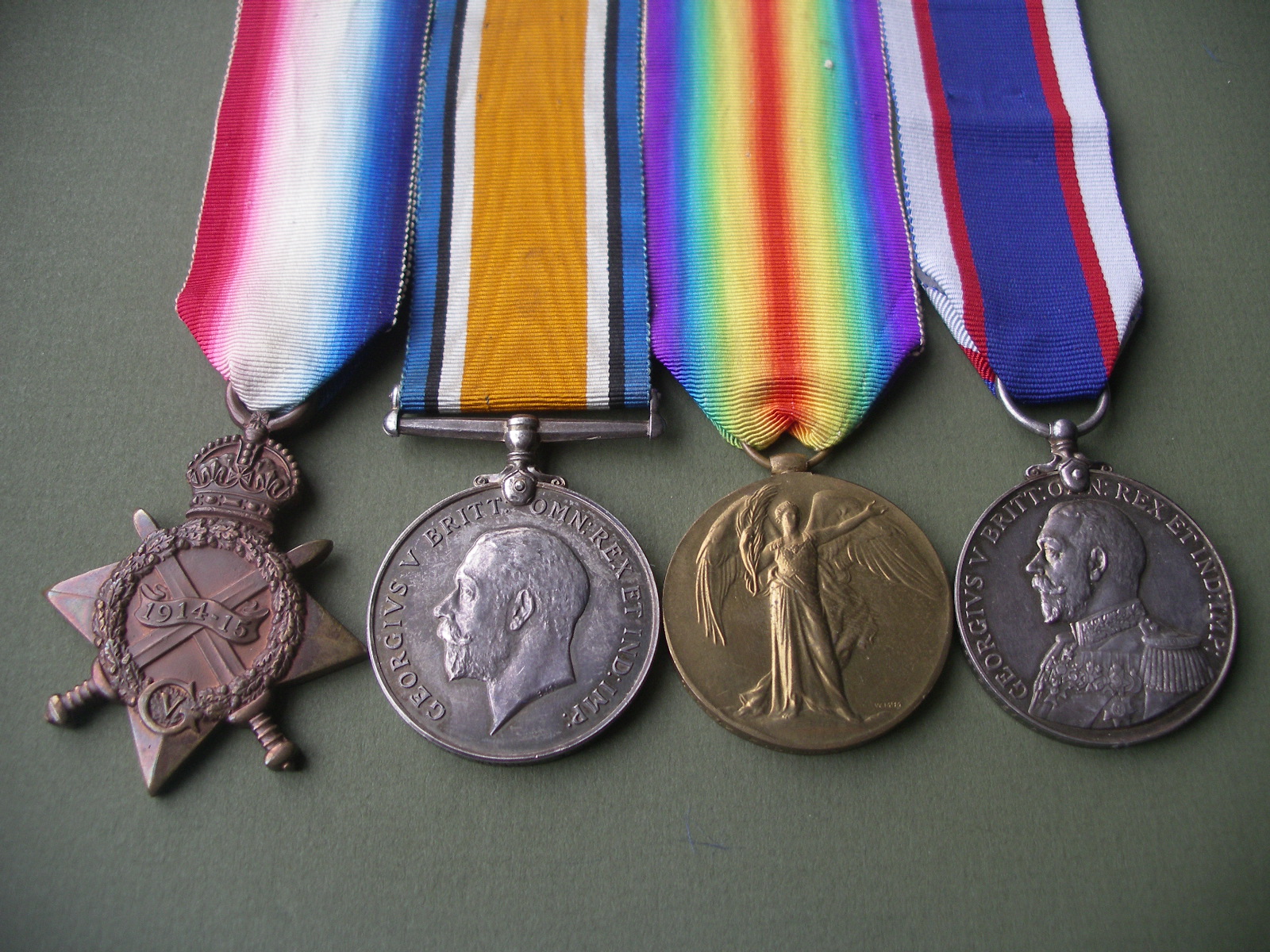
1914 - 15 Trio.
George V Royal Fleet Reserve Long Service & Good Conduct Medal.
186812 F. D. Wood, Yeoman of Signals, Royal Navy.


Frederick Daniel Wood was born on 20th August 1880 in Torquay, Devon. He appears on the 1891 Census as a 10 year old schoolboy, the son of Ann and Alfred, a commissioned boatman and coastguard. At this time the Wood family were living in one of the Coastguard Cottages at Dawlish. Frederick joined the Royal Navy on 11th January 1896 as a Boy 2nd Class. His service record describes him as just over 5 feet tall, with dark brown hair, brown eyes and a fair complexion. After a period of basic training at HMS Ganges, a shore establishment for the training of boys, and then at HMS Boscawen, Frederick first went to sea on the battleship HMS Collingwood in 1897. At this time, HMS Collingwood was coastguard ship at Bantry. Later service was on a number of ships, including HMS Wild Swan, HMS Imperieuse and HMS Benbow. While on the latter, Frederick was advanced to Leading Signalman.
Frederick was recorded on the 1911 Census as one of the 209 sailors serving on HMS Medea, a third class cruiser, in Malta harbour.


On 15th June 1912, Frederick joined the crew of the newly commissioned HMS Thunderer (pictured above in a painting by Frederick W. Bumford). He was soon rated Yeoman of Signals and would stay with this ship for the duration of the Great War, including service at the Battle of Jutland. You can read about HMS Thunderer here .

 
Frederick Wood left HMS Thunderer on 13th September 1919 and joined the Royal Fleet Reserve on 20th August 1920. His Royal Fleet Reserve LSGC Medal was issued on 15th March 1928.

Sergeant Sperring Of The Scots Greys.

Queen's South Africa Medal with clasps "Cape Colony", "Orange Free State", "Johannesburg", "Diamond Hill" & "Belfast".
King's South Africa Medal with clasps "South Africa 1901" & "South Africa 1902".
3843 Serjt. W. Sperring, 2nd Dragoons.

William Jones Sperring, a 20-year-old labourer from Somerset, attested for the 2nd Dragoons (Royal Scots Greys) at Aldershot on 14th August 1893. His Attestation Papers describe him as almost 6' 3" in height with brown hair, hazel eyes and a sallow complexion. His religion was given as Church of England. William's first six years in the army were all home service during which he received his 1st Good Conduct pay (14/8/93), appointment as Lance Corporal (27/1/98), promotion to Corporal (1/4/99), and appointment as Lance Sergeant (8/11/99).
Following the outbreak of war with the Boers, William Sperring served with the Regiment in South Africa from February 1900. The clasps on his Queen's South Africa Medal are evidence that he saw action in the fighting to capture Johannesburg in May and the Battles of Diamond Hill in June and Belfast in August. By the end of the year, the Regiment had lost 7 officers (4 died, 3 wounded) and 78 NCOs and men (35 died, 43 wounded). The majority of deaths were due to disease rather than enemy action.

On 18th April 1901, William Sperring was severely wounded in the abdomen when the Greys engaged the enemy at Weltevreden. According to "The History of the Second Dragoons 'Royal Scots Greys'" by Edward Almack
18th. - The regiment marched from Reit Vlei. Enemy were located by left flank guard about 7.30a.m. in strong position, and who opened with guns and rifle fire. B Squadron under Major R. H. Adams took a commanding position, on which enemy retired.
The Greys bivouacked at Weltevreden and the next day marched to Roodeval, under sniper fire the whole day. William Sperring was promoted to Sergeant on 25th September 1901 and at some point in December, probably because of the seriousness of his wound, he was sent back to England where he would stay until October 1902. On 23rd September of that year, he re-engaged to complete 21 years with the colours. Following this, he returned to South Africa to rejoin the Regiment, thus earning entitlement to the King's South Africa Medal. During this time William became ill with enteric fever and spent 116 days in hospitals at Wynberg and Simonstown. He remained in South Africa till June 1904 and had thus served a total of three and a half years there.
Back in England, William married Minnie Smart in the parish church at Kingsthorpe on Christmas Eve 1905. The couple had twin girls, Jessie Elizabeth and Gwendoline Rose, who were born on 20th June 1907, but sadly the latter appears to have died in infancy. A year later on 10th November 1908, a son, William John James, was born.
On the outbreak of the First World War, Sergeant William Sperring was posted to the 5th Reserve Cavalry Regiment on 16th August 1914. He saw home service with the 1st Dragoons until being finally discharged from the army at York on 13th August 1915 due to his age. He had served for a total of 22 years and his conduct was described as "exemplary". His only award for his service in the First World War was a Silver War Badge for "Services Rendered".
In later life, William Sperring and his wife Minnie ran the "The Sheaf & Sickle" public house in Long Lawford, near Rugby. William died some time in 1934 when he was aged about 60.


Thursday, 25 December 2014

From Private To Colour Sergeant.


British War Medal 1914 - 1920.
Victory Medal.
1998 A. C. Sjt. S. L. Clements, 15th London Regiment (Civil Service Rifles).

Sidney Leopold Clements was born in Forest Gate, Essex, and is listed on the 1901 Census as a 16 year old clerk, living with his father Stephen, a 55 year old stationer, and his siblings, Ethel (18), Olive (14) and Stafford (13). The family home was an 8 room dwelling at 39 Windsor Road, Forest Gate. The 1911 Census records Sidney as still living at home with his father. Interestingly, his occupation is given as registrar to the North Western Uruguay Railway Company.
On the day following the outbreak of the Great War, Sidney Clements presented himself at Somerset House in order to enlist in the 15th London Regiment (Civil Service Rifles). His attestation papers note that he had previously served as a territorial soldier with the same Regiment. The papers describe him as 5' 9" tall and of good physical development.
On the 17th of March 1915, the 1/15th Londons landed in France and, as a member of the original Battalion, Sidney Clements became one of the "17th of March Men", henceforth the proudest title bestowed on the men of the Civil Service Rifles. Sidney served on the Western Front until late November 1915, when he was admitted to the 1st Canadian General Hospital at Etaples. He was suffering from jaundice.

On the 7th February 1916, Sidney Clements rejoined the 1/15th Battalion and now began his rapid rise through the ranks. He was appointed unpaid Lance Corporal on 3rd March and paid Lance Corporal a week later. He was promoted to Corporal on 6th April, appointed Lance Sergeant on 25th July and promoted to Sergeant on 4th September.
There followed another spell in hospital, this time in England at the Lord Derby War Hospital, Warrington. Sidney was suffering from leg ulcers and although they rapidly improved with treatment, he had to stay in hospital for two months. Discharged from hospital on 25th November 1916, Sidney joined the 15th London Regiment's Depot and stayed in England until being posted back to the 1/15th Battalion on 17th July 1917.
On 22nd September, he was appointed Acting Colour Sergeant. Apart from two weeks' leave to England in early September 1918, Sidney would serve the rest of the war on the Western Front with the 1/15th Londons. He was appointed Acting Company Quartermaster Sergeant on 9th January 1919, and finally sent back to England to be demobbed a month later. He was discharged from the army on 12th March 1919. On the 2nd July 1921, Sidney Clements received the two medals shown here. 
 
When the history of the Civil Service Rifles came to be written after the war, Captain P. Davenport, M.C., who chronicled the deeds of the 1/15th Battalion, acknowledged his indebtedness to several gentlemen, including S. L. Clements, who had helped in the preparation of the work. Sadly, as recorded in the National Probate Calendar of England and Wales, Sidney Leopold Clements of Barcombe, St Brannock's Road, Ilfracombe, Devonshire died on 22nd December 1933 at the Devon Mental Hospital, Exminster, Devonshire. His effects, valued at £434 2s 4d, were left to his widow, Clarissa Isobel Clements.

Wounded At The Butte De Warlencourt.


Victory Medal.
4756 Pte. E. L. Sackett, 15th London Regiment (Civil Service Rifles).

Edward Leslie Sackett, the son of Edward and Rose Ellen Sackett, was born on 29th May 1896 in Blackheath, London. A daughter, Gladys Winifred, was born to the couple the following year. By the time of the 1901 Census, the family were living at 179 Horncastle Road, Skirbeck, Boston, Lincolnshire, where Edward's father was working as a tailor's cutter. Ten years later, as recorded on the 1911 Census, the family, now consisting of Edward (36), Rose (36), Edward (14), Gladys (13) and their third child, Sidney Charles Norman (8), were living at 93 Victoria Road, Charlton. In June 1912, young Edward joined the Post Office as a boy clerk, and achieved advancement to assistant clerk in December 1913 and clerk in May 1915.
Like many young men of his generation, Edward joined the army, enlisting in the 15th London Regiment (Civil Service Rifles) at Somerset House on 22nd November 1915. His Attestation Papers state his age as 19 years 6 months and record that he had blue eyes, a pale complexion, dark brown hair, "fair" physical development and that he was 5' 7" tall. On enlistment, Edward had signed Army Form E.624, agreeing "to serve in any place outside the United Kingdom." On 5th May 1916, he sailed from Southampton to Havre on his way to join the 1/15th Londons on the Western Front.
Edward joined the Battalion on 29th May, shortly after their involvement in some minor operations on the Vimy Ridge in which the Battalion, particularly 'B' Company suffered heavily. In late summer 1916, the 1/15th Londons moved to the Somme, taking part in two costly attacks, firstly at High Wood on 15th September and then at the Butte De Warlencourt on 7th October. In the words of the Regimental History "The losses on the 7th of October amounted to five officers, 344 other ranks, and although numerically they are not quite so great as at High Wood, it should be remembered that on this occasion the Battalion was not more than 500 strong at the outset." It was in this latter attack that Edward Sackett suffered a serious head wound causing a fracture of the skull. He spent ten days in hospital in France and was then evacuated back to England.


On his return, Edward was initially attached to the 15th London Regiment Depot but on 11th July 1917, he was transferred to the 616th (HS) Employment Company of the Labour Corps. He appeared before a medical board on 12th September 1917 and according to the report made at that time "On date mentioned he was wounded by a piece of HE shell which caused fracture and depression of skull (L. Frontal bone), was taken to No 2 General Hospital at Havre where he remained 10 days where a trepanning operation was performed and some pieces of bone removed. He was then taken to the Royal City of Dublin Hospital where he remained 9 weeks. An operation was done there to remove a small piece of metal from behind left ear. He was then discharged hospital and returned to this unit." The report continued "There is still a considerable depression at the site of the fracture. L. Frontal region. He is quite unfit for any exertion and gets quite giddy. No signs of paralysis and no history of it. Sight and hearing both good."
Edward Sackett was discharged from the army as "being no longer physically fit for war service" on 1st December 1917, having served for 2 years and 10 days. His Discharge Papers describe him as a "reliable and well conducted man." Three years after being wounded on the Somme, he was still suffering from headaches and giddiness, was categorised as having a 40% disability and was incapable of sustained work. Despite this, in 1923 he married Ethel Loten and lived to a ripe old age, finally passing away at the age of 94 in Southampton in February 1991.